
JLL Spark’s investment in Aston: Firm power infrastructure for the AI era

JLL Spark’s investment in Aston: Firm power infrastructure for the AI era



JLL Spark Global Ventures has participated in Aston’s Series A financing round, joining co-leads Building Ventures and TDK Ventures in backing what we believe is one of the most important infrastructure companies being built today. In this post, we share what drew us to Aston and why we see this as a defining investment for JLL Spark and the broader commercial real estate industry.
The problem: Power has become the new land
In the AI era, electricity is the foundational resource. Data centers, advanced manufacturing facilities, and next-generation industrial users require enormous amounts of reliable, uninterrupted power, and they need it now.
The grid cannot keep up. Nearly 2,300 GW of generation and storage is currently sitting in interconnection queues, with average wait times exceeding five years. In the most sought-after markets, shovel-ready sites with 50 to 500 MW of available power are essentially nonexistent. What little capacity exists often comes attached to tens or hundreds of millions in required upstream transmission upgrades, with no guarantee on timeline.
For JLL’s data center clients, hyperscalers, neoclouds, and colocation operators, this is the number one barrier to executing on their growth plans. Existing solutions are either temporary, single-site, or simply move the queue problem around rather than solving it. None provide the reliability guarantees that mission-critical operations demand.
That is where Aston comes in.
The solution: A private utility built for industrial-grade demand
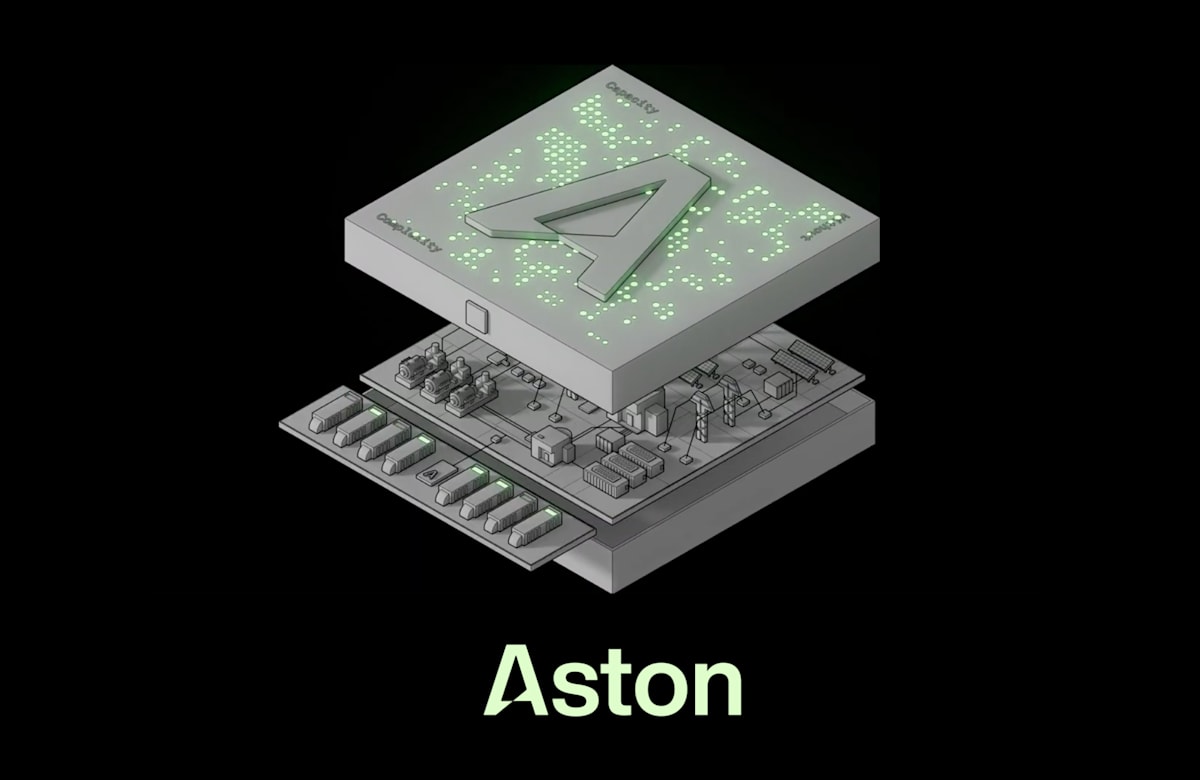
Founded in 2022, Aston is building a full-stack private utility for large power users. Rather than waiting in interconnection queues, Aston assembles power from multiple sources: on-site gas generation, stranded off-site renewables, battery storage, and available non-firm public utility power, delivering it as a single, firm, guaranteed service through one connection point.
The result is utility-grade reliability with startup speed: Aston can bring large users to power years ahead of what a conventional utility path would allow, backed by contractually committed service level agreements and risk insurance. This is not a temporary solution or a workaround. It is a permanent, scalable infrastructure model designed to sit alongside, and in many cases replace, the public utility as the power provider for the most demanding energy users in the country
A key differentiator for Aston is its network approach. The company treats each site as a node in a connected power network, enabling dynamic routing, shared redundancy, and energy arbitrage across multiple sites. One site’s surplus becomes another site’s supply. As the network scales, the economics improve nonlinearly without proportional increases in capital expenditure.
Why JLL Spark invested
For our clients, the impact is immediate. JLL works with the top hyperscalers, colocation data center owners, and neoclouds. Each is searching for a path to near-term power. As Mark To, one of our senior data center brokers, put it: “Aston has really been the only solution where we’ve had success in bringing large demand users to the table and showing them a path to near-term power.”
That competitive differentiation matters. The ability to solve the power problem, not just identify sites, is rapidly becoming the key differentiator between winning and losing mandates.
The market opportunity is substantial. McKinsey projects data centers will require approximately $6.7 trillion in capital investment through 2030. The segment focused on overcoming grid constraints for large loads represents $150 to $300 billion per year, with the energy trading opportunity expected to reach $100 billion annually by decade’s end.
The team is exceptional. CEO Greg Robinson founded Drift as a FERC-licensed retail power company and pioneered the first 24×7 commercial carbon-free energy contract. His leadership team brings decades of experience spanning utility engineering at PacifiCorp, infrastructure development across two million square feet of complex projects, energy trading at Shell, power commercialization at AWS, and large-scale distributed software at IBM and Oklo.
Aston is capital efficient. The company has four sites in development totaling 2+ GW power capacity across Albuquerque, Phoenix, Dallas, and Denver, having previously raised less than $10 million in equity financing. Its model is intentionally asset-light: infrastructure debt partners provide site-level financing, and Aston’s moat grows with each site added to the network.
Looking ahead
The AI buildout is creating generational demand for physical infrastructure, and power is the binding constraint. The companies that figure out how to deliver firm, reliable electricity to hyperscale and industrial users, faster and more flexibly than the public grid can, will occupy an extraordinarily valuable position in the economy for decades to come.
We believe Aston is one of those companies. Its technology, team, partner ecosystem, and early commercial traction are each impressive on their own. Together, they represent the kind of compounding advantage that makes for an enduring business.
We are proud to back Greg and the entire Aston team, and we look forward to growing this partnership as Aston scales its network across the country.
Interested in a strategic partnership with JLL Spark? Apply for an investment here.